banner1

What Do Cities Owe to their Dead? Urban Cemeteries In Toronto Are Running Out of Space to Bury the Dead
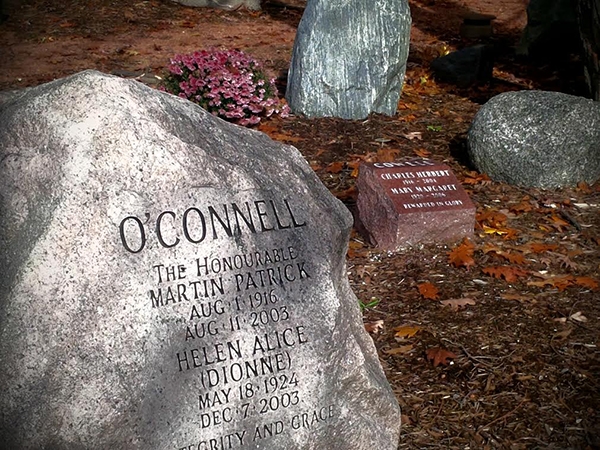
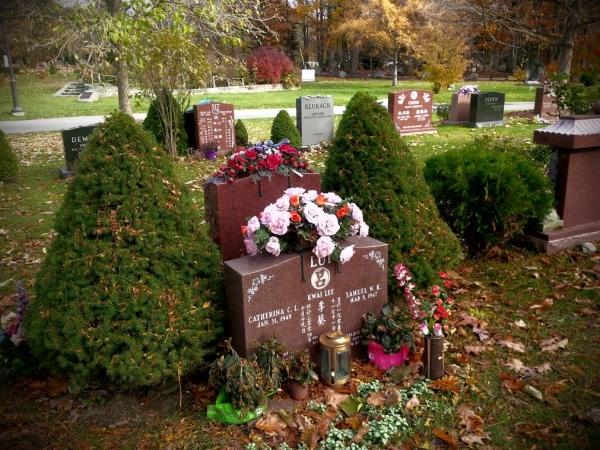
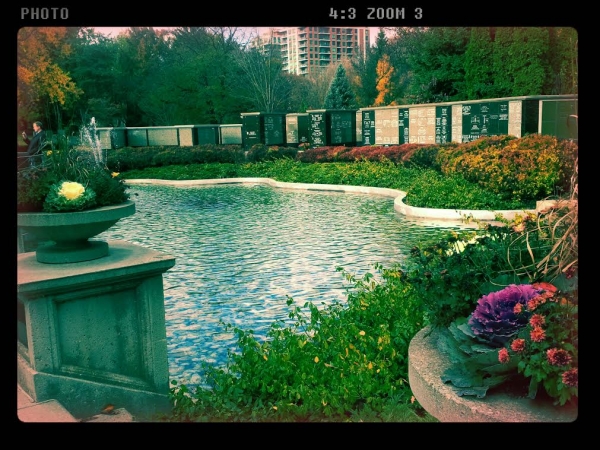

There is a lack of cemetery land in the Greater Toronto Area (GTA). More broadly, structures of city planning which do exist, do not adequately take account of the racial, religious, cultural, class differences and changing cultural practices of memorialization among the city’s population in urban cemeteries. Municipal city planning in Toronto has yet to address, how to equitably spatially plan for death in Toronto by designating the required zoning for cemetery land use in Official and Secondary Plans. Given the amendments in the Provincial Policy Statement (PPS), as part of the PPS review in 2014, the need to plan for cemeteries was addressed in language but not in full practice. Where, in part of the new PPS, released last year, the Ministry of Municipal Affairs and Housing (MMAH) added the word “cemeteries” to policy 1.1.1 b), the list of institutional uses that should be considered by planning authorities, to better recognize planning for all life stages:

“Healthy, liveable and safe communities are sustained by:
b) accommodating an appropriate range and mix of residential (including second units, affordable housing and housing for older persons), employment (including industrial and commercial), institutional (including places of worship, cemeteries and long-term care homes),recreation, park and open space, and other uses to meet long-term needs”.

However, with recent amendments to the PPS 2014, the City of Toronto has yet to implement planning for cemetery use in community planning or development applications through its Official Plan and Zoning By-Laws, given the diversity of Toronto. At the same time, Council which represent 44 Wards in Toronto do not make recommendations for cemetery land use given the religious and cultural diversity and changing cultural needs of memorialization of communities located in the 44 Wards which make up the City of Toronto. Death it seems is an equity issue which urgently needs to be addressed in planning and policy –with respect to equity, diversity and inclusiveness.

Continue Reading


  • Wednesday, August 26th, 2015
  • No Comment.


About Me

I'm Nicole N. Hanson (MES; Pl.), a cultural urban planner who links planning for vibrant communities, with planning for the full life cycle of cities: where we can live, work, play and die. I posses expert knowledge and experience in guiding cultural policy and development initiatives for cities in Ontario. Spatially Planning For Death In Cities' is my areas of specialization. This blog is a place where I share ideas on cultural planning, the creative economy, cemetery planning, urban evolution, the archaeology of performance and urban memory as an art of storytelling in cities.

Press Releases

York Region Official Plan Review: Cemetery Needs Analysis 2015

My Role: Stakeholder Focus Group - Contributes expert knowledge about York Region's future planning policies for siting new cemeteries based on research in urban and regional planning on 'Spatially Planning For Death In Cities'. On a provincial level, I contributed to the dialogue based my role as LRO at the Cemeteries and Crematoriums Regulation Unit; Ministry of Government & Consumer Services.

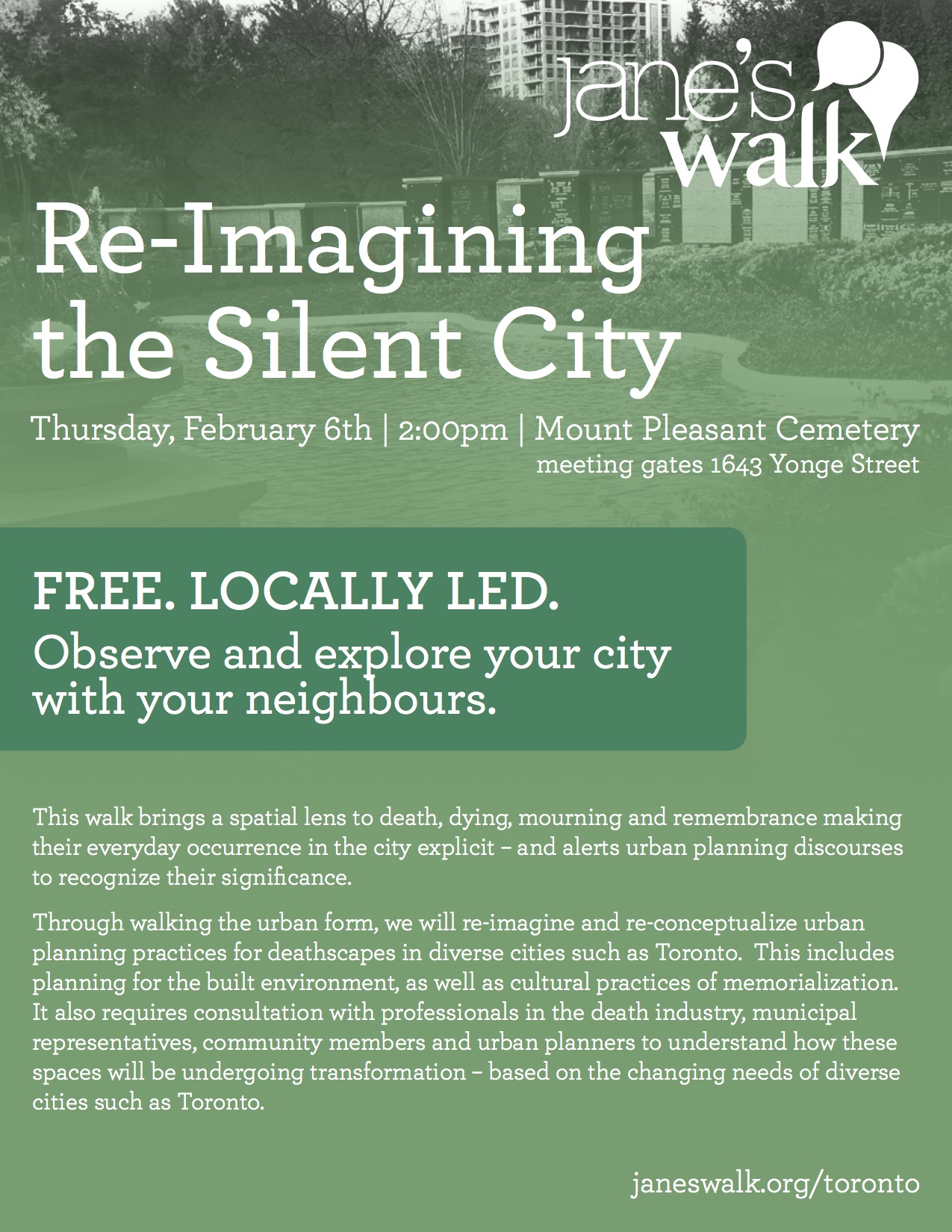
Spatially Planning For Death in Cities - 100 in 1 Day Toronto 2015
The Canadian Association of Planning Students ‐ L’Association Canadienne des Étudiants en Aménagement et Urbanisme (CAPS‐ACÉAU)
Blog Archive

Research informing Policy- Provincial Policy Statement, Official Plans & Secondary Plans and Social Development Policy:

  1. Spatially Planning For Death in Toronto; Planning Urban Cemeteries in Municipal City Planning in Ontario- Major Research Paper (MRP)
    Magisteriate of Environmental Studies; Urban & Regional Planning York University [Requested Upon Consultation]

Literature: Urban Spatial Theory

Basmajian, C., & Coutts, C. (2010). Planning for the disposal of the dead. Journal of the American Planning Association, 76(3), 305-317 doi:10.1080/01944361003791913


Byrne, J., & Wolch, J. (2009). Nature, race, and parks: Past research and future directions for geographic research. Progress in Human Geography, 33(6), 743-765 doi:10.1177/0309132509103156


Canadian Institute of Planners. 2011. Competency Standards for the Planning Profession in Canada. Available at www.cip-icu.ca/Files/Services-and-Programs/Competency-Standards-for-the-Planning-Profession-i


Chang, C. (2012). Before I die I want to. TED video, 6, 20.


Deathscapes : Spaces for death, dying, mourning and remembrance (c2010). In Maddrell A.,Sidaway J. D. (Eds.), . Farnham, Surrey, England ;: Ashgate.


Degen, M., & Rose, G. (2012). The sensory experiencing of urban design: The role of walking and perceptual memory. Urban Studies, 49(15), 3271-3287. doi:10.1177/0042098012440463


Eggener, K. (2010). Cemeteries. WW Norton & Company.


Harvey, David. (1978). The urban process under capitalism. International Journal of urban and Regional Research, 2(1-2), 101-131.


Heller, C. (1999). On Ecology of Everyday Life from Ecology of Everyday Life: Rethinking the Desire for Nature. Black Rose Books, 172-174.


Hodge, G. (2014). In Gordon D. L. A. (Ed.), Planning canadian communities : An introduction to the principles, practice, and participants (6th ed. ed.). Toronto: Nelson Education.


Cook, I., & Swyngedouw, E. (2012). Cities, social cohesion and the environment: Towards a future research agenda. Urban Studies, 49(9), 1959-1979. doi:10.1177/0042098012444887


Emotion, place and culture (2009). In Smith M., Davidson J. and Cameron L. (Eds.), . Abingdon, Oxon, GBR: Ashgate Publishing Group.


Harvey, D. (1985). The urbanization of capital (p. 8). Oxford: Blackwell.


Hubbard, P. (2006). City. Florence, KY, USA: Routledge.


Jeffrey S. Lowe. 2015. “Black Lives Don’t Matter in APA’s Colorblind Planning: APA Rejected Legislative Policy Guide on Criminal Justice”. Progressive Planning 203: 2,18-19.


Kipfer, S., Goonewardena, K., Schmid, C., & Milgrom, R. (2008). On the production of Henri Lefebvre. Space, difference, everyday life: reading Henri Lefebvre, 1-23.


Kipfer, S. (2007). Fanon and space: colonization, urbanization, and liberation from the colonial to the global city. Environment and Planning D, 25(4), 701.


Kipfer, S. (2002). Urbanization, everyday life and the survival of capitalism: Lefebvre, Gramsci and the problematic of hegemony. Capitalism Nature Socialism, 13(2), 117-149.


Keil, R., & Kipfer, S. (2003). 14 The Urban Experience and Globalization.Changing Canada: Political Economy as Transformation, 335.


Kovel, J. (2007). Enemy of nature : The end of capitalism or the end of the world?. London, GBR: Zed Books.


Macionis, J. J., & Parrillo, V. N. (2004). Cities and urban life. Pearson Education.


Maddrell, A. (2013). Living with the deceased: absence, presence and absence- presence, Cultural Geographies (special issue on Absence’, edited by Lars Meier et al).


Marcuse, Peter (2010). “Changing Times, Changing Planning: Critical Planning Today”. Progressive Planning 182, pp. 13-16.


McKittrick, K. (2013). Plantation Futures. Small Axe, 17(3 42), 1-15.


Melosi, M. (2010). Humans, cities, and nature: How do cities fit in the material world? Journal of Urban History, 36(1), 3-21. doi:10.1177/0096144209349876


Middleton, J. (2010). Sense and the city: Exploring the embodied geographies of urban walking. Social & Cultural Geography, 11(6), 575-596 doi:10.1080/14649365.2010.497913


Niemelä, J. (1999). Ecology and urban planning. Biodiversity and Conservation, 8(1), 119-131.


Parker, S.,. (2004). Urban theory and the urban experience : Encountering the city. London ;:Routledge.


Pratt, K. (2012). Rethinking community: Conservation, practice, and emotion. Emotion,Space and Society, 5(3), 177-185. doi:10.1016/j.emospa.2011.08.003


Ryan, Brent D. 2011. “Reading through a plan: A visual interpretation of what plans mean and how they innovate”. Journal of the American Planning Association, 77(4): 309-327.


Salleh, A. (1997). Ecofeminism as politics: Nature, marx, and the postmodern. London, UK: Zed Books Ltd.


Swedberg, R. (2011). The role of senses and signs in the economy. Journal of Cultural Economy, 4(4), 423-437. doi:10.1080/17530350.2011.609703


Thomas. June Manning. 2008. “The minority-race planner in the quest for a just city”. Planning Theory 7(3): 227–247.


Wheeler, S. (2004). Planning for sustainability : Creating livable, equitable, and ecological communities. London ;: Routledge.

About Me

I'm Nicole N. Hanson (MES; Pl.), a cultural urban planner who links planning for vibrant communities, with planning for the full life cycle of cities: where we can live, work, play and die. I posses expert knowledge and experience in guiding cultural policy and development initiatives for cities in Ontario. Spatially Planning For Death In Cities' is my areas of specialization. This blog is a place where I share ideas on cultural planning, the creative economy, cemetery planning, urban evolution, the archaeology of performance and urban memory as an art of storytelling in cities.

Press Releases

York Region Official Plan Review: Cemetery Needs Analysis 2015

My Role: Stakeholder Focus Group - Contributes expert knowledge about York Region's future planning policies for siting new cemeteries based on research in urban and regional planning on 'Spatially Planning For Death In Cities'. On a provincial level, I contributed to the dialogue based my role as LRO at the Cemeteries and Crematoriums Regulation Unit; Ministry of Government & Consumer Services.

Spatially Planning For Death in Cities - 100 in 1 Day Toronto 2015

The Canadian Association of Planning Students ‐ L’Association Canadienne des Étudiants en Aménagement et Urbanisme (CAPS‐ACÉAU)
Blog Archive

Information Coming Soon…


About Me

I'm Nicole N. Hanson (MES; Pl.), a cultural urban planner who links planning for vibrant communities, with planning for the full life cycle of cities: where we can live, work, play and die. I posses expert knowledge and experience in guiding cultural policy and development initiatives for cities in Ontario. Spatially Planning For Death In Cities' is my areas of specialization. This blog is a place where I share ideas on cultural planning, the creative economy, cemetery planning, urban evolution, the archaeology of performance and urban memory as an art of storytelling in cities.

Press Releases

York Region Official Plan Review: Cemetery Needs Analysis 2015

My Role: Stakeholder Focus Group - Contributes expert knowledge about York Region's future planning policies for siting new cemeteries based on research in urban and regional planning on 'Spatially Planning For Death In Cities'. On a provincial level, I contributed to the dialogue based my role as LRO at the Cemeteries and Crematoriums Regulation Unit; Ministry of Government & Consumer Services.

Spatially Planning For Death in Cities - 100 in 1 Day Toronto 2015

The Canadian Association of Planning Students ‐ L’Association Canadienne des Étudiants en Aménagement et Urbanisme (CAPS‐ACÉAU)
Blog Archive

Information Coming Soon…


About Me

I'm Nicole N. Hanson (MES; Pl.), a cultural urban planner who links planning for vibrant communities, with planning for the full life cycle of cities: where we can live, work, play and die. I posses expert knowledge and experience in guiding cultural policy and development initiatives for cities in Ontario. Spatially Planning For Death In Cities' is my areas of specialization. This blog is a place where I share ideas on cultural planning, the creative economy, cemetery planning, urban evolution, the archaeology of performance and urban memory as an art of storytelling in cities.

Press Releases

York Region Official Plan Review: Cemetery Needs Analysis 2015

My Role: Stakeholder Focus Group - Contributes expert knowledge about York Region's future planning policies for siting new cemeteries based on research in urban and regional planning on 'Spatially Planning For Death In Cities'. On a provincial level, I contributed to the dialogue based my role as LRO at the Cemeteries and Crematoriums Regulation Unit; Ministry of Government & Consumer Services.

Spatially Planning For Death in Cities - 100 in 1 Day Toronto 2015

The Canadian Association of Planning Students ‐ L’Association Canadienne des Étudiants en Aménagement et Urbanisme (CAPS‐ACÉAU)

Blog Archive

Information Coming Soon…


About Me

I'm Nicole N. Hanson (MES; Pl.), a cultural urban planner who links planning for vibrant communities, with planning for the full life cycle of cities: where we can live, work, play and die. I posses expert knowledge and experience in guiding cultural policy and development initiatives for cities in Ontario. Spatially Planning For Death In Cities' is my areas of specialization. This blog is a place where I share ideas on cultural planning, the creative economy, cemetery planning, urban evolution, the archaeology of performance and urban memory as an art of storytelling in cities.

Press Releases

York Region Official Plan Review: Cemetery Needs Analysis 2015

My Role: Stakeholder Focus Group - Contributes expert knowledge about York Region's future planning policies for siting new cemeteries based on research in urban and regional planning on 'Spatially Planning For Death In Cities'. On a provincial level, I contributed to the dialogue based my role as LRO at the Cemeteries and Crematoriums Regulation Unit; Ministry of Government & Consumer Services.

Spatially Planning For Death in Cities - 100 in 1 Day Toronto 2015

The Canadian Association of Planning Students ‐ L’Association Canadienne des Étudiants en Aménagement et Urbanisme (CAPS‐ACÉAU)

Blog Archive


About Me

I'm Nicole N. Hanson (MES; Pl.), a cultural urban planner who links planning for vibrant communities, with planning for the full life cycle of cities: where we can live, work, play and die. I posses expert knowledge and experience in guiding cultural policy and development initiatives for cities in Ontario. Spatially Planning For Death In Cities' is my areas of specialization. This blog is a place where I share ideas on cultural planning, the creative economy, cemetery planning, urban evolution, the archaeology of performance and urban memory as an art of storytelling in cities.

Press Releases

York Region Official Plan Review: Cemetery Needs Analysis 2015

My Role: Stakeholder Focus Group - Contributes expert knowledge about York Region's future planning policies for siting new cemeteries based on research in urban and regional planning on 'Spatially Planning For Death In Cities'. On a provincial level, I contributed to the dialogue based my role as LRO at the Cemeteries and Crematoriums Regulation Unit; Ministry of Government & Consumer Services.

Spatially Planning For Death in Cities - 100 in 1 Day Toronto 2015

The Canadian Association of Planning Students ‐ L’Association Canadienne des Étudiants en Aménagement et Urbanisme (CAPS‐ACÉAU)

Blog Archive